
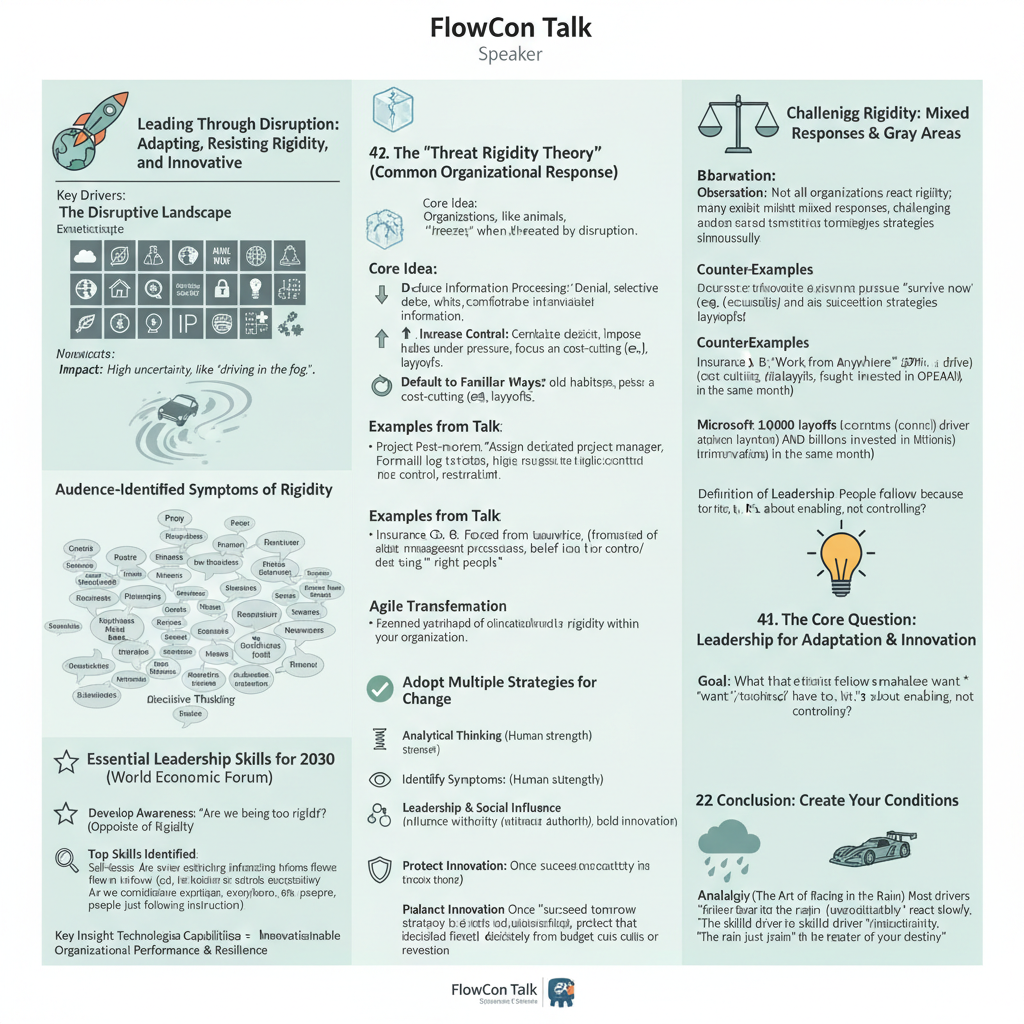
Talk Infographic
🚀 Leading Through Disruption: Adapting, Resisting Rigidity, and Innovating
🌍 The Disruptive Landscape
- Key Drivers: Pandemic, Geopolitics, AI, Generational Shifts (Gen X/Z), Remote Work, Work Ethos, Layoffs, Reskilling, Capital Flow, Privacy, IP, Energy, Supply Chains, Global Warming, Diversity & Inclusion.
- Impact: High uncertainty, like “driving in the fog.”
🧊 The “Threat Rigidity Theory” (Common Organizational Response)
- Core Idea: Organizations, like animals, “freeze” when threatened by disruption.
- Mechanisms:
- ⬇️ Reduce Information Processing: Denial, selective data, comfortable information.
- ⬆️ Increase Control: Centralize decision-making, impose rules, assign dedicated project managers.
- 🔄 Default to Familiar Ways: Revert to old habits under pressure, focus on cost-cutting (e.g., layoffs).
- Audience-Identified Symptoms of Rigidity:
- Control, Pray, Wait & See, Freeze, Denial, Panic, Pressure, Reacting Poorly.
- More planning, Rules, Punitive gates, More meetings, Overspecialization, Submission, More process, Attention on budget, Mandated AI usage, Hippo decisions, Silos, Burnout, Turnover, All decisions by higher-ups.
- Examples from Talk:
- Project Post-mortem: “Assign dedicated project manager,” “Formally log all topics” (more control, restricted info).
- Insurance Co. A: Forced return to office, high resignations, belief in having “the right people.”
- Agile Transformation: Stripped of social aspects, became a project management process for control/prediction, not adaptation.
⚖️ Challenging Rigidity: Mixed Responses & Gray Areas
- Observation: Not all organizations react rigidly; many exhibit mixed responses, challenging the “Threat Rigidity Theory.”
- Balancing Act: Organizations often pursue “survive now” (e.g., cautious cost-cutting) and “succeed tomorrow” (e.g., innovation) strategies simultaneously.
- Counter-Examples:
- Insurance Co. B: Work from anywhere, 30% higher pay, fostering innovation.
- Spotify: Implemented “Work From Anywhere” (innovation driver) alongside layoffs (cost-cutting), but fought to retain WFA.
- Microsoft: 10,000 layoffs (cost-cutting, control) AND billions invested in OpenAI (innovation) in the same month.
💡 The Core Question: Leadership for Adaptation & Innovation
- Goal: What kind of leadership enables organizations to adapt, be resilient, and innovate without succumbing to rigidity?
- Definition of Leadership: People follow because they want to, not because they have to. It’s about enabling, not controlling.
🌟 Essential Leadership Skills for 2030 (World Economic Forum)
- Top Skills Identified:
- Resilience, Flexibility, Agility (Opposite of Rigidity)
- Analytical Thinking (Human strength)
- Leadership & Social Influence (Influence without authority)
- Creative Thinking (Human strength)
- Key Insight: Technological Capabilities + Innovation Leadership = Sustainable Organizational Performance & Resilience.
✅ Actionable Steps for Leaders
1. Develop Awareness: “Are we being too rigid?”
- Self-Assess:
- Are we restricting information flow (e.g., Jira tickets over direct communication)?
- Are we centralizing controls excessively (e.g., managers everywhere, people just following instructions)?
- Identify Symptoms: Look for signs of involuntary rigidity within your organization.
2. Adopt Multiple Strategies for Change
- Balance: “Survive Now” (e.g., cautious cost-cutting) with “Succeed Tomorrow” (e.g., bold innovation).
- Protect Innovation: Once a “succeed tomorrow” strategy is identified, protect that decision fiercely from budget cuts or reversion.
3. Decentralize Power & Decision-Making
- Why? Antidote to centralization, increases information flow, builds resilient networks.
- How?
- 🤝 Enable People’s Agency: Create an environment where people feel safe to act with intention, speak up, and influence.
- 💬 Foster Communication & Alignment: Prioritize human connection and shared understanding over rigid tools/frameworks (e.g., OKRs, Jira) for alignment.
- 👂 Listen to Micro-Narratives: Pay attention to stories, feelings, ideas, and concerns shared informally, even in remote settings.
🌧️ Conclusion: Create Your Conditions
- Analogy (The Art of Racing in the Rain): Most drivers fear the rain (unpredictability) and react slowly. A skilled driver intentionally skids the car to control it.
- Message: Don’t just react to disruption. Proactively “create your own conditions” to navigate uncertainty. “The rain is just rain” when you are the creator of your destiny.
Main Questions Answered
Main Questions Addressed in the Talk
The talk primarily addresses the following questions:
- How are organizations responding to the current era of disruption and uncertainty?
- The speaker introduces the “threat rigidity theory” as a common response mechanism (freezing, restricting information, centralizing control) and solicits audience input on observed organizational reactions.
- Does the “threat rigidity theory” fully explain organizational behavior, or are there more complex and mixed responses to disruption?
- The speaker challenges the theory by presenting counter-examples of organizations exhibiting both rigid and innovative responses simultaneously, suggesting a “gray area.”
- What kind of leadership is essential for organizations to adapt, be resilient, and innovate in disruptive times without succumbing to rigidity?
- This is explicitly stated as the core question the speaker sought to answer, focusing on leadership that enables rather than controls.
- What actionable steps can leaders take to foster adaptation, resilience, and innovation within their organizations?
- The speaker provides three main suggestions: developing awareness of rigidity, adopting multiple strategies for change (survive now vs. succeed tomorrow), and decentralizing power and decision-making.
- How can individuals and organizations identify and address symptoms of involuntary rigidity in their operations?
- The talk encourages self-assessment by asking “Are we being too rigid?” and prompts the audience to identify specific symptoms of excessive rigidity in their workplaces.
Raw Transcript
Hello. And that’s basically all my French. No, I can speak a few words, but just a quick question for you. Um, I’m trying to wake you up slowly since. Um, should we wait a couple more minutes for more people to show up? No, no, no.
They’re not here, they don’t care, right? Okay, good. Okay, so thank you for being here. Um, my name is Andrea Provaglio, the name is Italian, I am Italian. Um, I will be presenting in English, but since I’m not a native English speaker, I hope my English will be understandable enough. Um, I’ll give you a little bit of background, not because I really care, but because I think it’s useful for you to know where my presentation is coming from. Um, I worked independently, always been working independently for the last 30 years, probably more. I come from information technology, I’ve been writing a lot of software. I’m helping a lot of people write a lot of software here in the United States, then I came here in Europe, and then United States and I came back. And in the last 15 years, I, I became more and more interested in the, let’s say, humanistic aspects of technical organizations. So I now what I do most of the time is I, I work with many different areas of the organization. I work with technical people, I work in HR. I work with product development. Sometimes I work with finance. I work with the, the C-suite sometimes. So my, my contribution when I work with a client is to try organization to be more adapt to to the 21st century, to the challenges we’re facing today. And when I say organization, of course, I’m referring to, um, technical, Oh, that’s interesting.
Do you think it would be better if I plugged in my, my power adapter? Okay. But no, what happened there, but anyway.
Um, yes, software organization, most of the time, I mean, digital organization, but I’ve been working with, um, oil and gas companies, for instance, or hardware manufacturing companies. Which means that, that gives me a pretty wide understanding of what it means for an organization to deliver value. Regardless of the size of the organization, the, um, the market in which that organization works and so on and so on and so on. So, one thing, and hence the title for this talk. One thing that I’ve been noticing in the last five or six years, and I, I would check with you guys, if you have the same impression. Um, is that there is some there’s been some kind of regression, that’s my personal experience, in the way many organizations operate. And I’ve been wondering why that happens. And I have some thoughts that I’ll share with you. we have one hour, so I hope you have your popcorns or whatever. Um, but if if that’s fine with you, I would rather not speak for one hour, I would really love some interaction with you, okay? So please, I know it is a very big room, you are very dispersed, I understand, shout out and, and try to make your feel heard, okay? So, let’s try to interact as much as possible. Um, so the first thing is, um, I have a question for you guys. And the question is this one. Can you tell me what you do without using your job title?
Okay, you need to. Do it.
Okay. Thank you.
Somebody in the back, I need to shout out very loud. I don’t know if that’s a French thing to do, but just do it.
Okay, so help your teammate, to have a good quality in what they do, okay? Thank you very much. Anybody else? Yeah, yes.
Help people work better together, and thank you for shouting from the first row. There you go.
Set an example for everyone. Okay, anybody else, what do you do?
Help people?
Directions. Oh, okay. So you are an a person, like the manager, leader. Okay, okay, okay. Okay. Good. Yes, anybody else in this area? You guys in the dark.
You guys have no idea how good your voice is from here.
Organization?
Okay, thank you. Thank you. Good. Okay, thank you very much. Now I just just to check the waters, as they say. Um, so let’s move on.
The title of this talk is leading through disruption. And I believe that we can agree that the years since the pandemic has been quite disruptive on a number of levels. Um, I have a few ideas about this, maybe you share them, maybe you don’t. But, um, the pandemic was definitely a source of disruption. the geopolitical situation of today and the years before today, is also a source of disruption. From the technology point of view, AI is definitely a source of disruption in the way we work, the way we operate. Then we have all the generational issues like Gen X and Gen Z. And if we go want to go a little bit deeper, the pandemic had an impact on remote work. the generational aspects have an impact on the work ethos, what we perceive as the right way to work. Um, if we talk about AI, AI is connected to layoffs, to re-skilling people. what else? where we spend capital, where capital is flowing these days. Um, then, of course, privacy or intellectual property. Um, from the geopolitical point of view, we have energy issues, geopolitical issues, supply chain disruptions. So, if you are a manager in this kind of environment, I mean, it’s not easy, right? Um, but anyway. This is just my idea, and then again, I, I’d like to hear. So to have your opinion as well. Do you think there is anything else, something I forgot to mention that comes to your mind?
Global warming, thank you very much. Thank you very much, totally overlooked that. Thank you. This, this is going to go in the next version of this presentation. Thank you. Um, anything else that I forgot?
Oh, so diversity and inclusion and, yes, of course, yes. Thank you. Good. Um, now, I know that you’re sitting very comfortably in your seat, but, um, you, you all have devices with you, right? So if we do a quick poll, would that be okay?
And the, the poll is this. How do you think organizations are responding to this kind of challenges, to the level of uncertainty, to the level of disruption, a friend of mine talks about talks about this, like, you know, driving in the fog? Okay? Um, so how do you think organizations respond to that? And, let’s see if we can do this nice trick.
Yep. I hope I am connected. Hmm. Yes.
I have no idea why I’m not seeing anything but
That’s a bit of a strange, right?
Okay. That’s all.
Oh, interesting. So it it looks like the first one is control. Right?
Uh, organizations tend to respond to this level of uncertainty by by imposing control, that’s that’s a general opinion here. We have pray, which, okay, we have faith in the future. Um, then wait and see, okay, which means freeze and see what happens. Um, some that organizations are reacting, some organizations are learning. Good.
And denial, also true, I’m gonna nothing is happening, it’s everything is under, is business as usual. Um, and, and many more. Okay, so thank you very much. Thank you, very useful. And,
panic mode. Yeah. Okay. Pressure. Oh, they’re reacting poorly. Are they or not? Okay, okay. Good, good. If you don’t mind, I will go back to the slide at this point. which was right here.
So, I’m very happy that you, well, I’m not happy, but it’s kind of reassuring for me that we kind of share common opinions. Now, there is a very, very old theory, which is called threat rigidity theory, which comes from the 80s, so we are talking about something that is almost 50 years old. And I’m not preaching this theory, I’m just using it as a starting point for a conversation. So, the threat rigidity theory basically postulates that, um, what you know how animals react when there is a threat, there is a usual you say the fight or flight response. Rather you run away or you fight, but there’s a third kind of response, which is freeze. Right? So, many animals where there is a threat, they just freeze and wait for for for the threat to go away. And since we share the same kind of brain, primitive brain as any other mammals on the planet. Somebody thought that maybe humans react in the same way sometimes when there is a threat for that, so they just freeze. And since organizations are, organizations do not exist in nature, right? Organizations are a group of people. So, since people make organizations and people react in a certain way, this theory postulates that maybe organizations react a similar way when there is a threat, which means they freeze. And more specifically, they, um, restrict, as you can see there, they reduce the amount of information processing, which is something related to the denial that you mentioned. Oh, no, no, there is no problem. Okay? Or maybe I just want to see the data that is comfortable, comforting, comforting to me, okay? So I only see what I want to see, that’s a reduction of information processing. Um, or they impose more control. And you guys mentioned control as the first thing that came up to your mind. Right? They impose more control because we are afraid, we don’t know what’s going to happen, we need to hold the wheel, okay? We impose more control. That’s a possibility. Definitely, and this theory, works at three levels. So, which is kind of interesting because it works at the individual level, meaning that individuals in the organization. Um, have this kind of response. So, for instance, they default to familiar ways of working. Which is something that we all do when we are under pressure. If you if you ever tried to change something, if you ever tried to change how a team works, okay? Have you ever noticed that a team can absorb some change as long as they are not under stress? But as long as a team goes under pressure, under stress, they revert back to the usual way of working. Okay? It’s very common, right? Okay, so that’s a possibility.
Um, we filter out information and so on and so on, we talk about that. That’s an individual level. There’s also the group level. At the group level, what happens sometimes is that the group become more cohesive.
But at the same time, it tends to be led by the louder voices, so there is more cohesion, but it’s the cohesion of a group that’s afraid, and we listen more to the people who speak louder, because we need to follow instructions. Okay? Okay.
And it also works at the organizational level. Then again, I’m not supporting this theory entirely, actually, I’m going to challenge it in a couple of minutes, but it’s a good starting point for thinking. The other thing that organizations do is centralizing control. Um, then again, filtering out data that they don’t want to see, a kind of confirmation bias, if you know what it is. And they focus on things that kind of promise more safety, like cutting costs. We are afraid. We don’t know what’s going to happen. Let’s cut costs. Let’s lay off 10,000 people. Let’s cut costs. and it also works at the organizational level. Then again, I’m not supporting this theory entirely. Actually, I’m going to challenge it in a couple of minutes. But that’s a good starting point for thinking. The other thing that organizations do is centralizing control, then again, filtering out data that they don’t want to see, kind of a confirmation bias, if you know what it is. And they focus on things that kind of promise more safety, like cutting costs. We are afraid, we don’t know what’s going to happen, let’s cut costs. Let’s lay off 10,000 people. Let’s cut costs. That’s a possible explanation for some of the things that we are seeing. I’m not, by the way, this is not a scientific research, so I cannot tell you that these assumptions are, in fact, correct. But it’s a starting point for reflection. Let me give you some more concrete examples. I’ve been working recently with a company, and, actually a friend of mine shared this with me. The company went through a postmortem for a project. They kind of came up with different solutions to problems they encountered during this project. And of course, this slide is terrible. I apologize for that, because it’s, you know, it’s a wall of words. You don’t have to read it all, but just see if you can spot some word that is particularly interesting for you. Like assign a dedicated project manager. Which kind of resonates to more control, right? We need a loud, a loud voice checking what’s going on and telling people what to do. Formally log and close all open discussion topics, blah, blah, blah, blah, blah, restrict kind of information. So if you read through these approaches they’re taking, they seem to support the threat rigidity theory. As a response to uncertainty, uncertainty and disruption. Let me give you another example. As I mentioned, I’m Italian, and I’ve worked for a couple of large insurance companies in Italy. Which, we will call insurance A and insurance B. Very big companies. Now at the end of 2003, or 2022, 2033. They had to decide what to do regarding the work from home policy. And Company A decided that they value face-to-face interactions very much. So everybody gets back to the office. Zero days of remote work, no matter what. Because we want to, we want to have you in the same room. We love you so much. That was their approach. Company B went the opposite way and they said, you know what, work from anywhere you want. We don’t care. As long as you get the job done, work from everywhere you want. By the way, we’re also paying you 30% more than the other company. Guess what happened to Company A? They had a lot of resignations, but it’s funny because I spoke to them, I spoke with the HR people and they told me, yeah, yeah, it was a very painful process, but now in our company we have the right people. Which means we have the people that we want to have. Okay? Which is, of course, I mean, it’s inevitable, you know, you, you place a very, very tough filter in the company and of course, you filter out all the people. If I want to work only with people with blue eyes, guess what, I will get a room full of people with blue eyes. Right? So, that’s what happened to them. So the question is, so how does this relate to the threat theory? One company, company A, decided that they wanted to have more control. Company B decided that they wanted to be more innovative. Okay? So two different companies that responded in two different ways. Which kind of invalidates part of the threat rigidity theory, because it proves that not all companies react in the same way. Then I’ll give you another example, which is a bit more, maybe you’re more familiar with it. Um, one thing that I’ve been observing as a, I’ve been in the Agile space for way too long. You, you know that. Um, so I’ve seen, okay, the first thing, the first time I heard about Agile was when I was living in the United States and it was at the end of 2000. Okay? So, I’ve been in the Agile space for like 25 minutes, and I’ve seen all the changes that happened in the last quarter of century. And one thing that happened in the last few years, in my opinion, as a, as an Agile professional, is that Agile has been stripped of all its social, um, implications. Agile has been turned into a project management approach, most of the time. If you look at the fact that Agile Alliance is now part of PMI. If you look at the articles that you can read on LinkedIn, which is all about how we use metrics, or how we do estimate, or which kind of, how should a Scrum Master behave during the standup, that’s a process. That is just a process. So, and then again, I’m thinking, hmm, okay. Maybe, maybe, we feel the need for more control, uncertainty, and so on, and so on, and so on. So we take something that was designed for adaptation, and we turn it into something that we use to control. And we use it because we hope we can predict, right? Even though Agile was never about right predictions. Agile was, has always been about creating a condition for change that allows you to change as fast as possible. That was Agile, adaptation. Adaptation. I have another question for you, but I, sorry if I spoiled it. I gave you three examples of rigidity, how a team reacted, how a company reacted, actually two companies, and how an industry reacted. Team, company, industry. Do you have more examples? Is there anything that comes to your mind that that could be an indication of rigidity? And maybe we didn’t spot it before because we were so distracted by all this disruption, but maybe there’s something there. So, let me, I, I believe I have to open the slider. Right? next one.
It should be open now, right?
No, that’s the previous one.
Okay.
Oh, sorry, my fault. Okay, let’s pretend that this one, let’s pretend that this one is the question I asked you, which means which kind of rigidity you you see. More planning.
Rules. Punitive gates. Politigate. Panic. More meetings. More informations. And I’m very sorry for my French pronunciation.
Overspecialization. Guidance, submission. More process. Passion. Bash ideas, interesting one. Thank you. Attention on budget. Yeah?
I’m a bit confused by collective ownership, but maybe you can explain it to me during the break. Um. Matrix, yeah. Dashboards. Process which don’t fit with how team works with, okay. I would call that process which don’t fit with our team work really, frameworks. We’ll probably call those frameworks. Okay. Oh, thank you.
The Russian matrix. Oh, oh. What the matrix?
More denial. More meetings, okay.
Okay, it seems that rules is still important.
Mandated AI usage, interesting. Mandated AI usage. Unfortunately, yes.
Okay, thank you. The hippo decision. Yeah, that’s another one. Good, thank you very much. Um, you think that’s okay? I mean, you’re having a lot of fun with this, I can tell you. Oh, finally someone that tells me express what they think. Okay. But I need to, we need to move on, is that okay? Can I go back to the slides? Okay, good.
Let me show you where we are. Good. Thank you very much. Thank you for helping me doing this presentation. Um, as I said, there are counterarguments to this threat rigidity theory. Um, because organizations do exhibit mixed responses. there are organizations who are, they become more rigid on one thing and they become less rigid on the other thing as a response to uncertainty because they need to innovate. Some organizations are trying to balance a survive now strategy like saving money on one side, and then use that money to innovate on the other side. So one is cost cutting, more, rigidity driven, the other one is invest in the future, so and they do those things together. Another criticism about the threat rigidity theory is that, um, somebody, the paper here went through all the literature and studies that support the threat rigidity theory and they said, okay, you know what, guys, you could have been, you could have done a better, scientifically proven study. Okay? So then again, I’m not, I’m not, I’m not an academic, I’m not here to question this. I’m just here to, um, provide some food for the brain.
I’ll give you an example of a mixed response approach. Um, a dear friend of mine has been in Spotify, now since moved on, but he’s been in Spotify for nine years. So I actually could validate, I could check this with him. In February 2021, Spotify introduced their work from anywhere program, which was actually advertised as part of their recruiting process. So if you work with Spotify, you can work from anywhere. And in one year, they observed that there were 50% less resignations, so people stayed in the company longer. There was an increase in women representation in the company, and there was an increase in the representation of black and Hispanic people in the company. Just because they introduced this work from anywhere policy. Unfortunately, at the end of 2003, probably as a response to the overhiring that we witnessed between 2020 and 2022, they started laying off people. Which, then again, is a cost cutting strategy, it’s a threat rigidity response. But at the same time, they fought very hard internally to keep in place the work from anywhere policy. So then again, two different approaches. One is, okay, we need to save money, we’re being hiring too many people. And the other one is, we want our people to be free to work from wherever they want, which, which was unheard of before 2020. So it was, in that case, disruption was a driver for innovation. Um, so that’s one thing. The other example I’ll give you is this one, Microsoft. it’s kind of funny because around January 2023, they did two completely opposite things. they laid off 10,000 people. That was their cost cutting approach, and they imposed more control in their organization. Oh, by the way, the information I’m giving here is documented in, in, studies that you can find. Oh, by the way, the information I’m giving here is documented in, in, studies that you can find. If you’re interested in the source material, just contact me on LinkedIn and I’ll be happy to share all the material that is here. Okay? So anyway, they provided more, they eliminated some teams including a team regarding AI ethics, that was completely canceled from the company. they centralized decision making, even more, around the decisions made at a very top level. And, then again, they tried to save money. For what? To invest in Open AI. So in the very the same month, they laid off 10,000 people, imposed more control, and gambled billions of dollars in a new technology. In the same month, okay? Which then again, makes you wonder if the threat rigidity theory applies all the time, or it is more, there’s more of a gray area. Now the title of this talk is leading through disruption. I’m very passionate about the meaning of leadership in organizations, and when I talk about leadership, I’m not talking about being appointed as a leader, because if you lead by authority, to me you’re not a leader. laid off 10,000 people in cost more control and gambled billions of dollars in new technology. the same month. Okay. Which then again is makes you wonder if the threat rigidity theory applies all the time or it is a more there’s more of a gray area. Now, the title of this talk is more is leading through disruption. I’m very passionate about the meaning of leadership in organizations. And when I talk about leadership, I’m not talking about being appointed as a leader, because if you lead by authority, to me, you’re not a leader. Leadership is when people follow you because they want to, not because they have to. Okay? So if your leadership role implies that people must follow your direction, you’re more of a manager or an executive or a person of authority, but you’re not a leader. So, I’m very interested in this kind of subtle concept of this leadership in organizations. Especially if it is a kind of leadership that enables things to happen, that enables people to do something, that enables people to act.
And so the question I asked myself in preparing this talk was actually the question before the talk. And it was which kind of leadership enables
organizations to adapt to these disruptive times, enables organizations to be resilient without being rigid. To be innovative rather than excessively cautious in what they do. So, that’s what I’d like to talk about at the moment. By the way, quick track because I’ve been talking for 31 minutes and 48 seconds. How are you guys doing?
You’re good. Need to stretch your legs, feel free to stand up if you want to. I don’t care really, do whatever you want.
Um, as long as you interact, I’m happy. Okay? Good. Moving into leadership then.
Um, this thing, oh, this report is almost one year old, which means it’s really old. and we hope they will produce a new one, very soon, but it’s basically a map of the skills that we believe this comes from the World Economic Forum. Okay? the report itself is 290 something pages long, very, very detailed. So this is just a small snippet. But this is a map that shows which skills we believe are relevant today, and that’s the horizontal axis. So the skills on your left are considered as normal things, things that we do normally. Um, and the skills on the right hand side are important today. And on the vertical axis, especially on the top, you have the skills that we believe are going to be extremely important in 2030, which is four years from now. And I understand that there’s a lot of information there, so I want to zoom in into a specific part, which is this one. So the top right corner, where you see that some of the skills that we believe are extremely important for the next four or five years are resilience, flexibility, agility. Which sounds to me as the opposite of rigidity.
Um, analytical thinking, something that humans can do very well, AI, not really. Um, leadership and social influence. So the ability to interact with other people, to influence your environment and to lead in a certain direction with no authority. And creative thinking, another thing that not many organizations, sorry, that AI cannot do very well. So, if this is true, and if it is true that the threat rigidity theory, in fact, is partially there, it means that we might be going the wrong direction, right?
We might be sometimes, I’m not it’s impossible and it would be extremely wrong to generalize in this case. But it is possible that sometimes we are excessively cautious and which is exactly what we shouldn’t be doing in times of disruption.
But let me tell you more about this.
There’s another study which is that from last year, okay? Um, then again, I’ll be happy to send you all the material I use.
Uh, that says that technological capabilities significantly influence sustainable organizational performance. Let’s translate it. If you want your organization to be to still be alive five years from now, 10 years from now, 20 years from now, okay, you need significant technological capabilities. You need to understand technology well. Okay, that’s fine, so far so good. Okay? Which in turns contribute to your resilience. I understand that. Okay, we live in a world that technologically is moving very fast, particularly when innovation leadership is present. Just mastering technology per se is important, but it’s not sufficient to make your organization thrive in the next five or ten years. So what we need is innovation leadership. Okay? That’s the assumption that again, you might disagree, I might disagree, but it’s something worth thinking about.
And if this is true, if innovation leadership is so important, coupled with, you know, technological literacy and coupled with resilience and everything, but if this is so important, leadership. What can we do if we lead? And then again, I’m not talking about leadership as a role, especially as an appointed role as a manager, I’m talking about leadership as our ability to influence our environment.
Sometimes for the good, sometimes for the bad. Because that’s the thing about leadership. Leadership can be used both ways. You could use it for good or you could use it for bad if you have the ability to influence your environment. But if we want to influence our environment for good, and we all can to some degree, okay, what can we do, especially if we work in organizations?
One suggestion that I have for you now that the thing is, the reason why I wanted to talk about the threat rigidity, blah, blah, blah, blah, is because it is my impression that we are not really aware of the psychological mechanisms that are driving our decisions in organizations. So what I’m saying is, hey guys, let’s reconsider the way you make decisions, maybe you’re making these decisions because you’re scared, because you’re confused. Because you don’t know about the future.
Because you’re worried. And of course that has a strong influence on how your organization responds. So one thing that might be worth trying, I don’t know, is just check.
Just check. Are we being too rigid? Are we being too rigid? Simple question. and that could be, for instance, um, are we restricting the circulation of information in any form? For instance, um, are we forcing people to document everything in Jira tickets but they don’t talk to each other? Because that would be a strong restriction for information for me.
Not allowing people to communicate face-to-face or even remotely, but communicate as human beings and not just as, you know, ticket processors.
Um, are we centralizing controls? Do we want to keep track of everything? Do we want to have managers here and there and there and people just following instructions? Are we doing any of this to any extent?
So, these are some suggestions. But if you’re still have a little bit of energy in your thumbs, I would like to hear from you. Just your thumbs, that’s all I need, okay, just your thumbs. Can we do that? Because there’s another slide here, which I believe I need to open and start.
Sorry. Next.
And that’s the question to you. Which symptoms of involuntary, rigidity. Would you if if somebody asks you, um, you know what, what’s your what’s your name? Oh, your name. Emily, okay, Emily, if somebody asks you, okay, you know what, just go look around the company and see if you can find any symptom of rigidity. Okay? What would you look for, you Emily and everybody? What would you look for? Which are the symptoms of excessive rigidity? Sickness, you mean physical sickness?
Just give me a thumb up or no. You mean physical sickness?
Or mental sickness? Burnout. Okay. Sudden quitting, demotivation.
Turnover.
Silos, okay.
If we wanted to look for something more measurable, not talking about KPIs, but something that we can really observe and touch. Like, touch, I mean, literally touch, um, something that we started doing and we didn’t used to do that before, but now we are doing this and this is making us more rigid. Okay? Shouting.
All decisions made by higher ups.
Okay, 3 4 5 9 0 7 4, I know that’s a phone number or maybe it’s a headline, I don’t know.
So one thing that we can do is to start looking in our organization and see if we see any sign on this. And, um, or at least some of these, not all of them, but some of these. And the question we might want to ask ourselves is, are we being too rigid in response to uncertainty and disruption?
I take, can I move back to the slides or you you still have something to type? You have, okay.
Thank you.
So, my first suggestion is develop awareness, start asking yourself, are we being too rigid in our organization? And you might find out that for some things, it’s perfectly okay to display this level of rigidity. And if you find out that for some things, it’s perfectly okay to to be very cautious, because maybe maybe those are the strategies that help your organization survive today.
Maybe we have to lay off a few people, we don’t want to, but maybe, or maybe there are other ways of saving money, okay? But we want to do that, because we have to, because we need to survive today. At the same time, we may have some to succeed tomorrow strategy. Here, and my recommendation is, if you do identify any kind of strategy that you believe will help you succeed tomorrow, and even if it takes a little bit of courage to try. My recommendation is, once you decide to go in that direction, a leader, protect that decision with your teeth. Okay, hold on to it. Because it is very easy, very easy, I mean, at the next budget review to revert back. To say, oh, you know what, now we can’t do that, okay, or we tried, but no, no, no, sorry, I’m not sorry. So if you identify such a strategy that you believe will help you succeed tomorrow and you’re in a leadership position. Hold on to it.
Uh, that is very, very important, because the temptation to go back to the blue side is very, very strong.
And
Okay, this slide alone could be a one-day workshop. Okay? And we don’t have that amount of time, but I’ll be happy to answer any questions later if you want to. My third suggestion is to decentralize power and decentralize decision-making as much as possible, and when I say as much as possible, I mean responsibly. Up to the point where it is almost unsafe to do it more. Okay? So why do we need decentralization? First of all, because it is an antidote to centralization of control. Secondly, because you provide more flow of information if you decentralize information decision-making, because that means that people do need to have access to information to be able to make good decisions. In general, that means that your system becomes more resilient because it becomes a network of people thinking and deciding rather than a hierarchy of people thinking and doing. Okay? Thank you very much.
Thank you very much for the you have five of left sign that up from the lady over here.
So, um, number one, how can you so decentralize, how can you do that? You can enable people’s agency, you have heard the term agency earlier on this stage. So agency is basically the capacity for people to act with intention, okay, to act with intention and to influence. And as a leader you can create an environment where this can happen, of course, as long as they feel safe enough to act and speak and see things in a certain way. Second thing is, forget about tools for a second. Like Jira, okay. Forget about frameworks for a second like OKRs. Oh. Oh. I touched the OKR button. What I mean is that OKRs are basically an alignment tool. That’s what we use OKRs for, to keep alignment. Okay? So if you need a tool to maintain alignment, use a tool. If you keep if you can stay aligned without a tool, you don’t need a tool. The the purpose is alignment.
It’s not using OKRs. The purpose is alignment. Thank you very much. Thank you very much for you have five minutes left to sign that paper. The lady over here.
So, um, number one, how can you decentralize? How can you do that? You can enable people’s agency. You have heard the term agency earlier on from this stage. So agency is basically the capacity for people to act with intention. to act with intention and to influence. And as a leader, you can create an environment where this can happen. of course, as long as they feel safe enough to act and speak and seek in certain way. Second thing is
Forget about tools for a second, like Jira, right? Forget about frameworks for a second like OKRs. Oh, Oh, I touched the OKR button. What I mean is that OKRs are basically an alignment tool. That’s what we use OKRs for, to keep alignment. Okay? What else is possibly? So if you need a tool to maintain alignment, use a tool. If you can if you can stay aligned without a tool, you don’t need a tool.
The the purpose is alignment. It’s not using OKRs, the purpose is alignment. Right? Or metrics, like you get. So forget about all those. So forget about tools, forget about frameworks, forget about metrics. How can you foster communication and alignment in your organization? Foster the distribution of circulation of information.
And then the other important thing is, people tell stories. People tell stories every day. at the copy machine, during a call, in an email message, they tell stories. These stories are important. They these stories are not quantitative data. You cannot attach a number to it. But they tell you a lot about how people are working. How people are feeling, if they have ideas, if they have concerns. And and of course it becomes more and more difficult to capture micro narratives if we live in a distributed, remote working environment. But it’s not impossible.
It’s not technically impossible.
It’s just a matter of practice.
So, enable people agency, agency, foster communication and foster alignment, which means help people understand where we are going and possibly know if they agree or not, and listen to micro narratives.
So this is the the three things I’d like to suggest, huh? Um, which were assess your rigidity. what was the other one? Oh yeah, multiple strategy for change. So one last thought and I think I have a few minutes. For some reason, when I was uh thinking about this presentation, which by the way it is the first time for for this presentation. Um, there was a movie that came up to my mind. I I like movies. Do you guys like movies?
Yeah? So maybe you have seen this one. Um,
I didn’t put any picture or anything as an instead one. Did you see The Art of Racing in the Rain, which is based on a book? It’s a very cute movie.
Uh, the movie is narrated by the movie is about a race car driver. And this race car driver has a dog. And the movie is narrated by the dog. The dog’s name is Enzo, like Enzo Ferrari. Okay, of course. And there is a dialogue in this movie, not between the dog and the and the race car driver, but between his girlfriend and the race car driver. So the girlfriend is looking at the the footage of a of a of a race. And she’s asking, so how come you go through the turns so much faster than the other cars?
And he says, well,
Most drivers are afraid of the rain because it is an unpredictable element. And we live in unpredictable times. So most drivers are afraid of the unpredictability of rain.
And so they forced to react to it. They react to what happens. But if you react at speed, that is very dangerous. So they prefer to go slow.
Interesting, good.
Well, and she says, well, you know, I’m scared just watching this. I scared just just watching it. And so our our driver says, yeah, but if you intentionally make the car do something, then you control the car.
And she asked, so you skid the car before the car skids itself?
It’s me skidding the car, not the car losing control. And he goes on, yeah, when I’m in a race car, I’m the creator of my destiny. And the last sentence in this dialogue is, create your conditions and the rain is just rain. Create your conditions, and the rain is just rain. And I think this applies to the disruptive times that we are watching today. Rather than trying to react that something is moving too fast, create your own conditions and just then does driving the race. I don’t know why this resonated with me, but I wanted to share it with you. That’s why I did. Okay? Um, and I’m done and I hope you enjoy the ride, so to speak. And I’m here for questions, I’ll be here until tomorrow, so I’ll be here for the whole conference. LinkedIn, so that’s my LinkedIn profile. If you want any other information, if you want the materials, I’ll be happy to share it with you. If you have a question, I believe we are like two minutes and then Hugo is next, which is fine, where she is but okay, but thank you very much.
Questions?
Do you have any example of creating one condition? Because that’s something that I I think can be can be quite a challenge. I can thinking about live at the office today. I don’t think it’s possible.
So the question is, um, do you have an example of creating your condition?
The real the most honest answer I can give you is no, because those must be your conditions, not mine. Okay. So, you know, I do not have an example of creating your condition. What’s your name?
Clara. Okay. Nice to meet you. So no, I don’t have an example of of creating your condition, but an example of creating conditions could be for instance, um, decide how we want to, if if we want or not people to be able to suggest new ideas in their organization whenever they want to.
Create a framework or create the condition so that everybody can speak up. And for instance, um, let let everybody know if they agree or not agree even with a CEO’s decision. Or, I don’t know if that applies to you. But then again, that could be something that could help in terms of exploring a larger set of options rather than focusing on just one thing. So, tweak your organization. When I say create your own conditions, I mean tweak your organization and your organization in your case could be a team of five people.
But if that’s your range, if that’s what you can change and you can influence that environment because you’re in a leadership position, do it. Create your conditions in a five people team.
That that’s what I meant. Then, the reason why I use this analogy of the race car driver is because you create your condition, which are scalable by definition, is not an easy condition, it’s not a comfortable condition. If you are driving a car and you make it skid, okay? It’s hard, it requires skills, it requires attention, it requires courage, but it’s your condition, you created that condition. You’re not responding to it. That’s the difference for me.
I hope that I will. But you can talk more, I mean, I’ll be here tomorrow.
Yeah.
Any other questions? Yes, we have my Italian friend here. so, um, if we bring this line of reasoning to the last consequence, why shouldn’t we all turn into entrepreneurship rather than sticking to employment? Which for the record, I already did, but that’s a
Okay. So why shouldn’t we become entrepreneurs?
That makes you an entrepreneur.
I yeah.
If that works for you, I’m totally fine. I mean,
Okay, so you’re saying that I’m just repeating the question for for them. Um, So and then I think we need to leave because Hugo is coming up. Um, so the point is, as an employee, you you do not really have control over your environment because many of the decisions or the environment is created by someone else. And I agree, um, but I’ve also seen it’s all a matter of where is your comfort zone and where is your zone of influence. Maybe you can just influence the relationship you have with four colleagues that you see 90% of the time. And so that’s where you create your own conditions. And then if you don’t like the conditions of the larger environment, then decide what to do, maybe you leave, maybe you stay. And but even if you stay, it’s your condition.
Okay. Thank you very much. I think I need to leave the stage, I’m sorry. Thank you very much.